Google
 
Showing posts with label Science. Show all posts

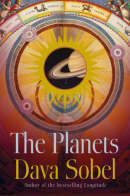
The Planets

By Dava Sobel

After the huge national and international success of Longitude and Galileo's Daughter, Dava Sobel tells the human story of the nine planets of our solar system. This groundbreaking new work traces the lives of each member of our solar family, from myth and history, astrology and science fiction, to the latest data from the modern era's robotic space probes. Whether revealing what hides behind Venus's cocoon of acid clouds, describing Neptune's 'complex beauty in subtle stripes and spots of royal to navy blue, azure, turquoise, and aquamarine', or capturing first-hand the excitement at the Jet Propulsion Laboratory when the first pictures from Cassini at Saturn were recently beamed to earth, Dava Sobel's unique tour of the solar system is filled with fascination and beauty. In lyrical prose interspersed with poems by Tennyson, Blake and others, The Planets gives a breathtaking, intimate view of those heavenly bodies that have captured the imagination since humanity's first glimpse of the glittering night skies. This extraordinary book of science, history, biography and storytelling will engage and delight. It is at once timely and timeless, and of infinite relevance to this age in which new planets are being discovered elsewhere in our galaxy, around stars other than the Sun.

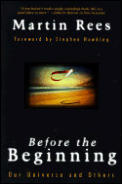
Before The Beginning: Our Universe and Others


Sophisticated instruments and spacecraft expeditions probing deeper into space have all increased our knowlege of the universe and its place in the grand scheme of things. From the theoretical insights to experimental confirmations, this book describes the universe and our quest to understand it. Rees, the well-known cosmologist and director of Cambridge University's Institute of Astronomy, outlines the historic context and explains discoveries and ideas (both his own and those of his colleagues) with clarity and in an engaging style. He successfully avoids jargon and formulas, but numbers, being too important to leave out, are mentioned in the order of magnitude rather than values. What makes this book unique is the radical theory that Rees puts forth. He asserts that there is an infinity of universes, besides our own, that were and are being created. None but our own is observable because of the hostility of the other universes' environment to intelligent life. Rees argues his case eloquently and without invoking theological issues.

"Although we cannot observe them (and they may be forever inaccessible), other universes are a natural expectation from current cosmology. Moreover, many features of our universe that otherwise seem baffling fall into place once we recognize this." Sir Martin Rees, the British Astronomer Royal, gives a vivid, occasionally acid tour of current astrophysics and cosmology, with insights into scientific politics, such as the enormous increase in the cost of the space telescope because of its association with the Space Shuttle. He also offers keen observations on personalities such as Subrahmayan Chandrasekhar and Isaac Newton, Yakov Zeldovich and Albert Einstein. Joseph Silk calls Before the Beginning "an unusual blend of wit, asperity and cosmology ... a combination of clarity and conciseness."

God's Equation

By Dr. Amir Aczel

In a work that is at once lucid and profound, renowned mathematician Dr. Amir Aczel, critically acclaimed author of Fermat's Last Theorem, takes students into the heart of science's greatest mystery. In January 1998, astronomers found evidence that the cosmos is expanding at an ever-increasing rate--the way we perceived the universe was changed forever. The most compelling theory cosmologists could find to explain this phenomenon was Einstein's cosmological constant, a theory he conceived--and rejected---over eighty years ago. Drawing on newly discovered letters of Einstein--many translated here for the first time--years of research, and interviews with prominent mathematicians, cosmologists, physicists, and astronomers, Aczel takes us on a fascinating journey into "the strange geometry of space-time," and into the mind of a genius. Here the unthinkable becomes real: an infinite, ever-expanding, ever-accelerating universe whose only absolute is the speed of light. Awesome in scope, nuanced in detail, God's Equation is science writing at its finest.

Review by Randomhouse

Understanding the Present: An altnernative History of Science

A science and philosophy columnist for the Sunday Times of London, Bryan Appleyard is looked upon by many as one of today's most outspoken and articulate critics of science. When Understanding the Present appeared in 1992, it topped the bestseller lists in England amid a storm of controversy. The scientific journal Nature called it "dangerous" and an "assault on reason" and Time magazine noted that the book was partly to blame for a rising tide of antiscience in the West.

The book explores the history of science, from the dawn of the Enlightenment up to the present day, arguing that its triumph in almost every sphere of human activity, spectacular though it is, has come at a high price. In spite of its effectiveness -- or, indeed, because of it -- science has cut the individual adrift from his moorings, depriving him not only of a sense of ultimate meaning and purpose but also from the possibility of ever finding them. For science denies the conviction that value and meaning can be found in the facts of the world and, worse still, defines all truths as provisional, as hypotheses yet to be verified or refuted. As such, science is unable to coexist with alternative explanations and systems of belief. It renders all non-objective truths invalid.
If science were merely a methodology, this would not be a serious problem. But today science has become the dominant way of understanding the world and our place in it. It shapes our political lives, our economics, our health, and, thanks to Sigmund Freud and his intellectual heirs, even our understanding of ourselves.

The burgeoning power of science also spells trouble for liberal democracy, he insists, for it advances the idea that for every problem there is a technical solution. It waves aside questions of ultimate value and purpose as mere opinions, and since opinions are subjective they carry no weight in the public square. And yet, he says, "people live unliberal lives. They have values, convictions, preferences and loyalties by which they order the world and make it work."
Science, writes Appleyard, "makes it progressively more difficult to sustain either a morality or a spiritual conviction. Daily, liberal-scientific man is made aware of the arbitrariness of the exercise. He finds he cannot even defend his position because all arguments end in the blank inconclusiveness of the total mutual tolerance that is the one thing required of the combatants. 'We agree to differ' is the standard form toward which all conflicts in liberal society end."
One of science's most stunning achievements, in Appleyard's view, is the defeat of religion. The sheer energy, power, and effectiveness of science has today weakened the spiritual beliefs to the point where they are regarded as viewpoints among many others -- merely opinions. While religion may answer questions that science does not, the source of its answers are no longer believed, and therefore neither are its answers. Attempts have been made to reconcile religion and science. But according to Appleyard, it is "idle to pretend, as many do, that there is no contradiction between [them]. Science contradicts religion as surely as Judaism contradicts Islam -- they are absolutely and irresolvably conflicting views."

Appleyard devotes a chapter each to the emergence of environmentalism as a new kind of religion and to the metaphysical speculations accompanying advances in relativity, quantum mechanics, and chaos theory -- the three major scientific achievements of the twentieth century. In both cases, he is sympathetic but ultimately skeptical that these developments can relieve the existential crisis brought on by the rise of the scientific worldview. He is especially wary of scientists like Stephen Hawking and Carl Sagan who believe in the possibility of a grand, unifying "Theory of Everything," or those champions of artificial intelligence who are working on the construction of "conscious" machines.

As Appleyard sees it, the "humbling" of science is essential if we are to regain confidence in the truth of our inner experience and in the enduring truths of traditional belief systems. By this, he means that science must be recognized for what it is: "a form of mysticism that proves peculiarly fertile in setting itself problems which only it can solve." The effectiveness of science is deceptive, he says. It begins by saying that it can only answer certain types of questions and ends by saying that only those types of questions can legitimately be asked. "Once the implications and shallowness of this trick are realized, fully realized, science will be humbled and we shall be free to celebrate our selves again.”

This is a beautifully written and carefully argued book, one that stands head and shoulders above all the recent works examining the tense relationship between science and religion, and one that points the way toward a more humane, post-scientific culture for the 21st century.
Bryan Appleyard is a science and philosophy columnist for the Sunday Times of London
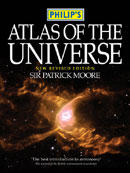
Philip's Atlas of The Universe

By Sir Patrick Moore

"Philip's Atlas of the Universe" is a definitive reference to the stars, the planets and the universe written by Britain's best-known astronomer, Sir Patrick Moore. For this new edition, the text has been fully revised and updated to include the latest discoveries made by the most recent space missions. It contains a wealth of photographs and superb star maps. It is suitable for both beginners and more experienced stargazers.
Fully revised and updated, this atlas provides an informative guide to the cosmos. Written by one of Britain's best-known astronomers, it contains a wealth of photographs from ground-based telescopes and the Hubble Space Telescope, as well as images from nearly four decades of robotic exploration of the planets. Tables of data and 22 star maps accompany information on the stars, solar system and the universe. Practical advice for beginners and more advanced astronomers, including how to choose a telescope, is also included.

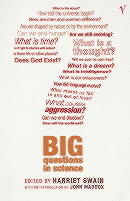
The Big Questions in Science

Edited by Harriet Swain

What is life about? How are men and women different? How did the universe begin? We all ponder these questions from time to time but some scientists spend their lives investigating them. Are they anywhere near finding answers? In this book, leading scientific thinkers address 20 of the really big questions that people have been asking for hundreds of years. The contributors include: John Sulston, who led the British side of the Human Genome Project and who offers his views on whether we can ever end disease; Susan Greenfield, Oxford University professor of pharmacology, who describes what she thinks is a thought; John Barrow, Cambridge professor of mathematical sciences, who tells us what is time; and American psychologist David Buss, who suggests why we fall in and out of love. Their answers are each put into context by more general commentaries discussing the differing views of other leading contemporary scientists and looking at how people have tackled the question in the past.

The result is a tour of scientific thought through the ages and a peek at some of the most cutting-edge and controversial research today. Packed with fascinating insights, it shows how science is investigating problems that affect us all on a large scale and suggests that we are closer to finding solutions to some of life's big questions than we might think.